| Legler Systems Company | | | AP System | | | Contact Us | | | Help | | | Home | | |
The Accounts Payable System (APS) developed by Legler Systems in California (CA) is based on the client-server model and supports many special features for handling the trade accounts payable and cash disbursement functions in small to midsize businesses. This customizable online APS software can be run as a stand-alone accounting application to manage trade payables and vendor check payments or integrated with other financial modules, such as the Check Reconciliation System and General Ledger System. This online Accounts Payable software utilizes a character-based user interface with mouse support on desktop or laptop computers for fast data entry and optimum end-user productivity in a multi-user environment.
The latest APS software version is now available with recent changes described in the Accounting Software Revision History document. The latest updates include four different real-time transaction dashboards under the accounts payable menu, plus the Report History Dashboard showing the prior runs for each reporting procedure and inquiry procedure. This general-purpose Accounts Payable System is easy to use and can function with or without a mouse for greater end-user flexibility and productivity.
After installations on different hardware and operating systems, this reliable accounts payable software has evolved over the last 25 years to an efficient, proven and productive business application for today under Microsoft Windows 10. Custom versions of the online APS software support in-house control of confidential accounts payable transaction records and have been in day-to-day operation in small businesses in Northern California for many years.
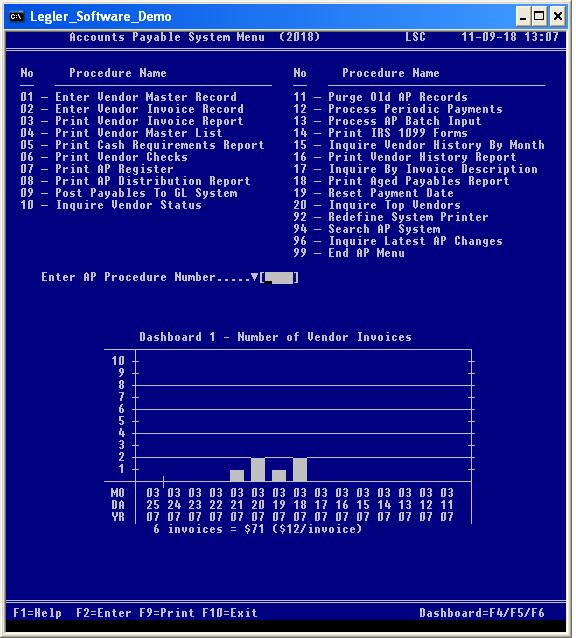
The online accounts payable (AP) accounting procedures are identified on the Accounts Payable System Menu (screen image shown below). Before any online AP procedure is run, the user must first sign-on by entering a valid User-ID and password. To display the Accounts Payable Menu from the main Financial Menu, enter "AP" to the System-ID prompt. To start a specific AP accounting procedure, enter the 2-digit number associated with that online accounting procedure or single-click the left mouse button when pointing to the procedure name on the Accounts Payable System Menu screen. The active keyboard function keys are identified at the bottom of all screens, including the accounts payable menu screen.
Data entry procedures AP01 (screen image) and AP02 (screen image) display the data fields that comprise each vendor record and perform the update functions (add, modify and delete) to the online Master File (DBSMST) based on a Transaction Code. A Vendor Master Record (vendor name and vendor address information) must be entered into the AP System before the vendor's invoices are entered and paid. The Accounts Payable Data Dictionary (printed by procedure DB11) defines each data field in data entry screens AP01 and AP02. Data entry procedure AP19 (screen image) provides a fast way to reset the payment date on a group of vendor invoices to delay the printing of a vendor check with stub by procedure AP06.
The online Help File contains a description of all AP data fields and AP error messages that are displayed in a separate Help Message Window whenever keyboard function key F1 is pressed. A drop-down list of valid codes for a field (marked by a down-arrowhead) is also shown in the Help Message Window when the F2 key is pressed after the F1 key. The Help Message Window temporarily overlays the bottom half of the basic application window (Command Prompt window).
For all AP inquiry procedures and reporting procedures, a selection screen is displayed so the user can enter various data selection parameters to retrieve specific data records from the online database (DBSMST) and to format the output. Prior data selection parameters are shown in the Report History Dashboard under the selection screen.
Online Inquiry procedures AP10 and AP15 display paid invoices or unpaid vendor invoice information for any vendor and time period. Inquire Vendor Payment History (AP15) shows a results screen by month for 5 years of vendor payment history. Search procedure AP17 allows the user to search and display vendor invoices based on a description. Inquiry procedure AP20 displays the top vendors based on vendor payments for any time period. Inquire Latest AP Changes procedure (AP96) displays a list of the latest Vendor Master Records (AP01) or Vendor Invoice Records (AP02) in descending chronological date sequence.
Online reporting procedures AP03, AP04, AP05, AP07, AP08, AP16 and AP18 print accounting reports on a line printer (computer-size paper) or a laser printer (letter-size paper). Accounting reports can be displayed in the basic application window or in a separate report window prior to printing a hardcopy. Reporting procedure AP05 identifies the vendor cash requirements (unpaid invoices) for each vendor. Reporting procedure AP06 is run to print vendor checks with check stub on "multi-purpose laser check" forms. Reporting procedure AP14 prints the annual 1099-MISC forms or creates an export file (diskette) based on IRS specifications. Reporting procedure AP18 prints future unpaid vendor invoices. Each online reporting procedure displays a separate selection screen for the user to enter report selection parameters, such as dates, codes, vendor number, report format option and report sort option. Update procedures AP09, AP11, AP12 and AP13 print a one-page APS Control Report showing the number of vendor records processed for audit documentation.
Data entry procedure AP12 automatically rolls-over recurring vendor payments, such as lease payments, from one month to the next to avoid manual re-entry each month and prints the Periodic Payments Report along with elapsed execution time in seconds. Update procedure AP09 posts all expense account codes in the Accounts Payable System to the General Ledger System for a specific accounting period (YRMO).
Auxiliary data input to the Accounts Payable System processes multiple vendor invoice transactions at one time to edit and load them into the online database using update procedure AP13. These auxiliary transactions were first entered into another computerized application that created the import Transfer File (fixed length records). Alternatively, a csv data file can be imported using update procedure DB18 to create the import Transfer File for subsequent input to the AP Batch Input procedure AP13. CSV Data Files contain variable length records where data values or fields are separated by a comma. Generally, a csv data file uses the internal ASCII coding structure.
Accounts payable procedure 92, procedure 94 and procedure 96 are the same procedures in the Database Control System. When 99 is entered as the AP procedure number, the main Financial Menu is displayed. End-user procedures DB03, DB11, DB17 and DB18 appear only on the Database Control menu.
Each online AP accounting procedure identified on the Accounts Payable System Menu is described in more detail in the AP Procedure Menu document, including a description of the accounts payable transaction dashboards and the Report History Dashboard.
In addition to the operational, security, technical and customization features mentioned in the Accounting Software Overview document, important Functional Features and Objectives of this proven accounts payable software are highlighted below:
1. Online processing involves instantly viewing, adding and changing vendor master and vendor invoice data in the online Master File (database) based on a transaction code (Trans-Code) for added accuracy. One invoice transaction is processed at a time.
2. Schedule unpaid vendor invoices for future payment by due date to better manage the trade accounts payable activity and vendor cash requirements. The payment date for a group of vendor invoices can be quickly reset by procedure AP19.
3. Maintain control over laser check numbers used by the APS software, so missing physical checks with stubs are identified each time the Print Vendor Checks procedure (AP06) is run.
4. Automatic expense account code assignment occurs when new vendor invoices are manually added by procedure AP02. These predefined GL expense account codes in the Vendor Master Record are automatically assigned to the new Vendor Invoice Record to minimize data entry effort. Both expense account codes (debit entry) and the trade payables account code (credit entry) are posted to each new vendor invoice. Recording of expense account data follows the standard GL account code structure of either a 4-digit account code only or a 4-digit account code plus a 2-character department number as set by System-Option-26 in procedure DB03. The GL expense account codes (debit entry) generally begin with "7" (7xx or 7xxx). The expense account codes can be manually assigned or overridden using data entry procedure AP02.
5. Automatic update of yearly purchase totals in the Vendor Master Record identify major vendors and avoids special year-end clerical steps.
6. Identify the vendor invoices paid by printing the invoice number on the vendor check stub by procedure AP06.
7. Flexible online reporting capability allows the user to request and print 44 different Trade Accounts Payable Reports, including vendor laser checks with check stub (AP06) by specifying report selection parameters and a report sort option. One-time ad-hoc accounting reports are easily printed.
8. Print the check amount text in uppercase letters and lowercase letters on the vendor check with stub for anti-fraud protection. For EBCDIC coding associated with mainframe computers (IBM Zsystem), System-Option-07 must be set to 6 or 7 in the Company Control Record (DB03), otherwise the ASCII coding structure is assumed.
9. Print the vendor address from Vendor Master Record on multi-purpose laser checks for direct mailing to the vendor.
10. In the real-time List Dashboard (No. 4), ten oldest unpaid vendor invoices are shown under the Accounts Payable Menu. Up to 4 different real-time transaction dashboards of key performance indicators for accounts payable are displayed; two real-time Bar Chart Dashboards and two real-time List Dashboards. A Report History Dashboard is displayed under the parameter prompts for an AP reporting procedure and inquiry procedure showing the last 12 runs.
11. Support batch job processing, where report selection parameters are entered online for later batch job processing by a separate job script, so large accounting reports (long running tasks) are printed offline.
12. In the AP System, special notes (comments, instructions or significant events) are entered and displayed from data entry screens AP01 or AP02 by dynamic linking to data entry procedure DB17 (General Notes Record) using keyboard function key F7 or the mouse when the word "NOTES" appears.
13. Enable vendor number lookup by vendor name when the "#" character is entered in the vendor number field and then enter the vendor's name or contact name or phone number when prompted. Both uppercase letters and lowercase letters are tested. When only one matching vendor is found, the associated vendor number automatically replaces the "#" character to eliminate the manual entry of the vendor number. This special vendor number lookup feature is performed when "#" is entered in the Vendor-No prompt. This "#" feature is in addition to the standard vendor number lookup by vendor name initials (uppercase) in both a client-server (ASCII coding) and IBM mainframe (EBCDIC coding) environment.
14. Automatically calculate a vendor discount available at the time vendor invoices are added to the online database by procedure AP02. If the vendor invoice is paid by the due date, then the vendor discount is subtracted from the invoice amount by procedure AP06 to get the check amount.
15. Support for either the accrual method (default) or cash method of accounting is set by System-Option-19 in the Company Control Record (DB03).
16. Auxiliary data input involves processing multiple vendor invoice transactions in the import Transfer File using update procedure AP13 to edit and add them to the online database.
17. Cobol source programs have been revised to reference a new common Copy member (SLP310) for the IBM AIX system call to execute the Unix chmod command, when an output file is opened and the OPR-SYS-PARM field is set to "AIX".
18. A complete backup of the accounts payable application is created by periodically copying the LSC directory to an external removable device, such as a compact disc (CD-ROM) or USB flash drive (thumb drive). The CD-ROM disc or USB flash drive can be stored off-site for added protection in case of an unforeseen disaster. The financial application can be started directly from these backup devices on any computer.
19. Handle employee or consultant reimbursement checks with stubs for travel and per diem expenses.
The online APS software references four master records in the Database Control System (required) to: (1) control basic system options and functions (Company Control Record), (2) verify User-ID and password and define the computer procedures the user can access plus other user options, such as the screen color code (background color and foreground color), display real-time dashboards, show dollar sign ($) in all dollar amount fields and Help Message Window screen color codes (User Control Record), (3) validate the GL expense account codes and other user definable codes, such as Pay Code and Location Code (Code Definition Records) and (4) identify special notes or comments about a vendor or vendor invoice by displaying the word "NOTES" on a data entry screen (General Notes Record).
At month-end, procedure AP09 formats and creates General Journal Records. Depending on the setting of System-Option-04 (DB03), these General Journal Records are written to: (1) an export Transfer File for input to an external GL application or (2) directly into the online database for subsequent use by the Legler General Ledger System (optional). The General Journal Records contain dollar amounts associated with each GL expense account code assigned to vendor invoices and vendor payments in the AP System.
Depending on the setting of System-Option-20 (DB03), the AP System formats and adds Check Records directly into the online database whenever vendor laser checks with check stub are printed by procedure AP06. These Check Records are referenced by the online Check Reconciliation System (optional) for monitoring issued and paid (by the bank) company checks. In addition, procedure DB18 can export these Check Records to a separate Text File of comma separated values (CSV Data File) for subsequent input to an external bank reconciliation application.
The online Mailing List System (optional) imports Vendor Master Records (vendor names and vendor addresses) from the Accounts Payable System and creates new Name Address Records in the ML System (procedure ML09) for subsequent printing of vendor mailing labels and computer letters, as may be required.
The AP System interfaces with a new Purchase Order System (optional) to print vendor purchase orders. The online PO accounting procedures are described in the PO Procedure Menu document.
This user-friendly APS software supports dynamic linking between data entry procedures (such as AP02 to AP01) with a single keystroke (function key F7). The linking data field is marked by an up-arrowhead. Dynamic linking to existing General Notes Record (DB17) containing special notes about a vendor name or vendor invoice is performed with one or two keystrokes (F7) or double-click of the left mouse button when the word "NOTES" appears on a data entry screen.
Update procedure DB18 in the Database Control System is used to: (1) export vendor invoice and vendor payment data from the online Master File to a Text File (csv data file) for subsequent input to an external computer application, (2) import vendor invoice data from a csv data file (variable length records), reformat csv records into fixed length data records and create the input Transfer File for subsequent editing and updating of the Master File by procedure AP13, and (3) support master file creation of vendor master data in a similar manner as vendor invoice data. Vendor Master Records must be loaded into the online database first, before the Vendor Invoice Records.
The Accounts Payable System operates on any x86 personal computer (desktop or laptop) in the Command Prompt window using any version of Microsoft Windows operating system from Windows 3.1 to Windows XP (16-bit) and Windows 10. The APS source programs are compatible with 32-bit cobol compilers (such as Micro Focus Net Express) that generate executable code for Windows 10 (64-bit version). Personal computers can be connected in a local area network (LAN) with complete flexibility in specifying the disk location of master files on the client laptop or desktop computer or the file server. Additionally, the APS software can be run on a single stand-alone personal computer or on a Unix based computer, such as the IBM RS/6000 with IBM 3151 terminals using the IBM AIX operating system. This Accounts Payable software has been ported to the HP-3000 computer and IBM mainframe computer (Zsystem). In addition to the standard application window size (80x25), a larger Command Prompt window of 80 characters wide by 50 rows (80x50) is supported for greater usefulness and allows real-time dashboards to be displayed under the accounts payable menu.
The 2017 version of the accounts payable software supports 32-bit code (.dll) or 16-bit code (.exe) depending on the OPR-SYS-PARM setting ("WIN" or "DOS") in the DBSPGM file. The exe programs run under Windows XP and the dll programs are used with Windows 10. AIX programs use the .gnt code. The AP application programs (32-bit code) run on 64-bit hardware.
The Run Time Environment for Micro Focus COBOL support is included at no extra cost with the APS executable programs. The Windows 10 accounts payable programs (32-bit code) are the same programs as the DOS accounts payable programs (16-bit code) for compatibility. For vendor data archiving and historical reporting, the same APS executable programs can be run offline from a removable device, such as a compact disc (CD-ROM) or USB flash drive; thereby eliminating the need to restore old vendor data and AP application programs to a separate hard disk drive in order to view or print accounts payable reports.
The Database Control System by Legler Systems Company is required to support online Master File updates in a multi-user environment. The Database Control System is included with the Accounts Payable software. The APS source programs are written in structured ANSI COBOL (COmmon Business Oriented Language), the most widely used business programming language, for easy maintenance in a client-server (ASCII code) or IBM mainframe (EBCDIC code) environment. A Micro Focus cobol compiler is used to generate the APS executable programs for personal computers using 32-bit addressing. Each AP accounting procedure identified on the Accounts Payable System Menu screen corresponds to a separate application program.
The AP System software cost is identified in the Software Price Sheet and includes: (1) APS executable programs for the Microsoft Windows environment, (2) APS Procedure Manual and (3) online Help File. The technical APS Systems Manual and APS source programs with common Copy members in the ANSI COBOL language can be purchased separately.
To request sample accounting reports and screen formats or a free working demo of this user-friendly AP System on a USB flash drive or CD-ROM disc for any version of Microsoft Windows, e-mail Bill Legler in the San Francisco Bay Area, CA.
Legler Systems Company, developer of the online Accounts Payable software, is located in the East Bay of the SF Bay Area in Northern California and provides local on-site APS software sales and support. E-mail support is always available regarding APS software questions or issues.